

Ear wax — medically called cerumen — is not dirt. It is not a sign of poor hygiene. It is a deliberately produced protective substance that the ear canal manufactures to trap dust, debris, and bacteria before they reach the eardrum. In most people, it migrates naturally out of the canal through jaw movement and the slow outward movement of canal skin — and never needs intervention of any kind. The problem begins when this self-cleaning mechanism fails, wax accumulates faster than it can clear, or well-intentioned cleaning habits push wax deeper into the canal and compact it against the eardrum. At Aashwi ENT Hospital, Dr Mihir Mehta sees earwax impaction cases every week — and the single most common finding is that the patient’s own cleaning attempts caused the problem in the first place.
Ear Wax Build-Up: Safe Removal Methods and What You Should Never Do
What Earwax Actually Is and Why the Ear Makes It
Cerumen is produced by specialised glands in the outer third of the ear canal — the ceruminous glands and sebaceous glands working together. The substance they produce is a mixture of fatty acids, alcohols, lysozyme (an antibacterial enzyme), and shed skin cells. This composition makes cerumen mildly acidic, which inhibits bacterial and fungal growth in the canal. It also forms a physical barrier that prevents water from sitting on the eardrum surface after swimming or bathing.
The ear canal has a natural conveyor-belt mechanism—the skin of the canal migrates outward from the eardrum toward the canal entrance at approximately the same rate as fingernail growth. Cerumen rides this outward migration, carrying trapped particles with it. Jaw movement during eating and speaking accelerates this process. In most adults, cerumen reaches the outer canal opening, dries, and flakes away without any awareness.
When this mechanism is disrupted — by narrow canal anatomy, hearing aid use that prevents natural outward migration, or cleaning habits that disrupt the skin migration pathway — wax accumulates. When cotton buds, hairpins, or fingers push accumulated wax inward, it compacts against the eardrum and loses the ability to clear itself.
When Wax Becomes a Problem — Symptoms of Impaction
Cerumen impaction produces a specific set of symptoms that most adults recognise individually but do not connect to wax:
- Sudden or gradual hearing reduction — particularly after showering or swimming, when water causes the wax to swell against the eardrum and abruptly worsen the blockage
- A blocked or full sensation deep in the ear that does not change with swallowing or yawning
- Tinnitus — a low-pitched ringing or buzzing, often described as a rushing sound, from the wax vibrating with ambient sound against the eardrum
- Earache — dull, pressure-type discomfort from the wax pressing on the eardrum surface
- An echo quality to the person’s own voice — hearing your own voice amplified inside the blocked ear
- Reflex cough — the auricular branch of the vagus nerve supplies the ear canal; wax pressing on this branch can trigger a persistent dry cough with no respiratory cause
Hearing changes after water exposure are clinically diagnostic. If muffled hearing appeared specifically after showering or swimming and has not cleared, cerumen impaction is the likely cause until proven otherwise.
What Never to Do — The Cotton Bud Problem
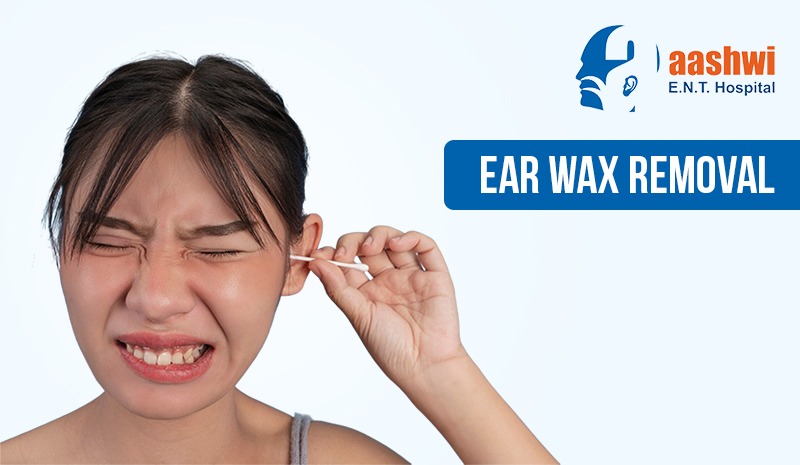
Cotton buds are the most counterproductive ear hygiene tool available, and they are stocked in every pharmacy. The ear canal is shaped such that a cotton bud inserted into it pushes wax inward rather than removing it — the swab collects a small amount from the surface while compacting the bulk of the wax plug deeper into the canal toward the eardrum. Repeated use gradually builds a firm impaction that the canal’s natural migration mechanism can no longer shift.
Beyond compaction, cotton buds cause three specific types of damage that Dr Mihir Mehta sees regularly at Aashwi ENT Hospital:
- Canal skin abrasion — the outer third of the canal skin is thin and richly vascular. Repeated cotton bud use removes the protective cerumen layer, abrades the skin, and creates micro-lacerations that allow bacteria to enter — predisposing to otitis externa in a canal that had no infection before the cleaning began.
- Eardrum trauma — the eardrum sits only 2.5 centimetres from the canal entrance. A cotton bud inserted beyond the cartilaginous outer canal, or one pushed in during a sudden movement, contacts the eardrum directly. Eardrum perforations from cotton bud trauma are a specific and entirely preventable injury seen in ENT clinics across India.
- Impaction of debris against the eardrum — foreign material pushed against the eardrum — including the cotton tip itself, which occasionally detaches — cannot be removed without specialist tools. It sits against the most sensitive membrane in the ear and continues to accumulate around it.
The correct guidance is unambiguous: nothing smaller than an elbow goes in the ear. The ear cleans itself. Intervention is needed only when the self-cleaning mechanism fails — and intervention means a clinic, not a cotton bud.
Safe Ear Wax Removal Methods — What Actually Works
- Softening drops — at home, for mild build-up: Olive oil, sodium bicarbonate drops, or commercially available cerumenolytic drops (such as Earex or Waxsol) soften wax enough for the natural migration mechanism to clear it over several days. Two to three drops warmed to body temperature — tested on the wrist — are instilled into the ear canal with the head tilted, held for five minutes, then allowed to drain. This process, repeated daily for five to seven days, is effective for soft, recently accumulated wax. It does not work for hard, impacted wax that has been building for months.
- Irrigation — in appropriate cases: Warm water irrigation — using a syringe to deliver a controlled stream of water into the canal — softens and dislodges wax mechanically. It should only be performed after several days of softening drops to ensure the wax is not dry and hard. Irrigation is contraindicated in anyone with a known or suspected eardrum perforation, a history of ear surgery, or ear pain — water entering the middle ear through a perforation causes immediate severe vertigo and risks inner ear damage. In the clinic setting, Dr Mihir Mehta uses controlled irrigation with appropriate technique when indicated.
- Microsuction — the safest and most effective clinical method: Microsuction uses a fine suction probe under direct vision through an operating microscope or otoscope. It removes wax precisely without water and without contact with the eardrum or canal walls when performed correctly. It is the method of choice for:
- Hard, impacted wax that softening drops have not shifted
- Anyone with a perforation or history of ear surgery where water must be avoided
- Wax adjacent to the eardrum requiring precision removal
- Children and elderly patients in whom irrigation carries higher complication risk
Microsuction at Aashwi ENT Hospital is performed by Dr Mihir Mehta — not a nurse or technician — using direct visualisation throughout the procedure. It takes under ten minutes per ear and produces immediate hearing improvement in the majority of patients.
Who Gets Recurrent Wax Build-Up — and Why
Some adults accumulate wax faster than others for identifiable anatomical and physiological reasons:
- Narrow or tortuous ear canals — canal geometry that slows the natural outward migration of cerumen
- Hearing aid users — the hearing aid mould occupies the canal and physically prevents wax from migrating outward; daily cleaning of the mould and regular professional wax removal every three to four months is standard maintenance
- Older adults — cerumen glands produce drier, harder wax with age, and the skin migration mechanism slows; impaction rates are highest in adults over 65
- Hairy ear canals — more common in older men; canal hair traps wax and prevents outward migration
- History of cotton bud use — disrupted skin migration from long-term cotton bud use produces chronic recurrent impaction even after the habit is stopped
For patients with recurrent build-up, Dr Mihir Mehta schedules preventive microsuction every three to six months — before symptoms develop — rather than waiting for impaction to produce hearing loss each time.
Frequently Asked Questions
How do I know if my ear is blocked by wax or something else?
Wax impaction typically produces gradual hearing reduction, a blocked sensation, and sometimes tinnitus — often worsening after water exposure. Middle ear fluid from infection produces a similar hearing change but is accompanied by ear pain, pressure, or a history of recent upper respiratory illness. An otoscopic examination at Dr Mihir Mehta’s clinic at Aashwi ENT Hospital distinguishes between the two immediately — wax is visible in the canal, while middle ear fluid requires looking through a clear canal at the eardrum.
Is it safe to use ear candles for wax removal?
No. Ear candles — hollow fabric cones burned at the outer end while the inner end sits near the canal — have no evidence of effectiveness and carry documented risks including canal burns from dripping wax, eardrum perforations from the candle itself, and fires from the burning wick. Studies examining ear candles consistently find that they do not generate negative pressure sufficient to draw wax out of the canal. They are a hazard, not a treatment. No ENT specialist recommends them.
Can hydrogen peroxide be used to clean ears?
Diluted hydrogen peroxide (3 percent) has cerumenolytic properties — it releases oxygen bubbles that soften and break up wax. It is used in some commercial ear drop preparations. Used occasionally for soft wax, it is generally safe in an intact ear canal. Concentrated hydrogen peroxide, or use in an ear with a perforated eardrum, can cause canal irritation and chemical damage. Commercially prepared cerumenolytic drops at the appropriate concentration are a safer and more consistent choice.
Why does hearing worsen after showering if I have wax?
Dry wax conducts sound reasonably well even when partially occluding the canal. Water causes wax to absorb fluid and swell, increasing the degree of canal occlusion abruptly. A person who has had gradual, unnoticed wax build-up often first becomes aware of it when showering produces a sudden, dramatic hearing reduction. This worsening after water exposure is one of the most reliable clinical indicators of cerumen impaction.
How often should ears be professionally cleaned?
In healthy adults with no tendency toward excessive wax production, no professional cleaning is required unless symptoms develop. Hearing aid users should have professional wax removal every three to four months. Adults with recurrent build-up from narrow canals or previous cotton bud use typically benefit from preventive microsuction every four to six months. Elderly adults with documented slow wax clearance benefit from annual professional ear hygiene checks.
Where can I get ear wax removed safely in Ahmedabad?
Dr Mihir K. Mehta at Aashwi ENT Hospital, Bodakdev, Ahmedabad performs microsuction for ear wax removal under direct visualisation. No softening drops are required before the appointment — Dr Mihir Mehta assesses the wax type and consistency on arrival and proceeds accordingly. The clinic is at 25, Sumangalam Co-op Housing Society, Drive-In Road, opp. Sunset Drive Cinema, Bodakdev, Ahmedabad – 380054. Contact: +91 997 989 1672.
The Ear Cleans Itself — Until Something Stops It
Most ear wax problems begin with a cleaning attempt. The ear that was clearing itself adequately was disrupted by a cotton bud, a hairpin, or an ear candle — and what followed was an impaction that the canal could no longer resolve alone.
Dr Mihir Mehta at Aashwi ENT Hospital provides safe, precise ear wax removal in a single visit — with direct visualisation throughout and no risk of the complications that unsupervised home methods carry.
Book your ear cleaning appointment today.
 Aashwi ENT Hospital — 25, Sumangalam Co-op Housing Society, Drive-In Road, opp. Sunset Drive Cinema, Bodakdev, Ahmedabad – 380054
  +91 997 989 1672
  Dr Mihir K. Mehta — MBBS, DLO, MS-ENT | 23+ Years ENT Experience
For more information, click on the link below:
Dr Mihir Mehta, Satellite, Ahmedabad | Top ENT, Throat, Nose, Sleep Apnea Doctor, Specialist